The Engine Room of Crime
Vice City's neon-lit entertainment district and Ambrosia's waterfront mansions get all the attention, but Leonida's criminal economy runs on infrastructure that most people never see. The state's industrial zones — sprawling complexes of refineries, warehouses, shipping yards, and processing plants — form the backbone of an underground economy that moves billions of dollars in contraband annually. These aren't glamorous locations, but they're where the real money is made.
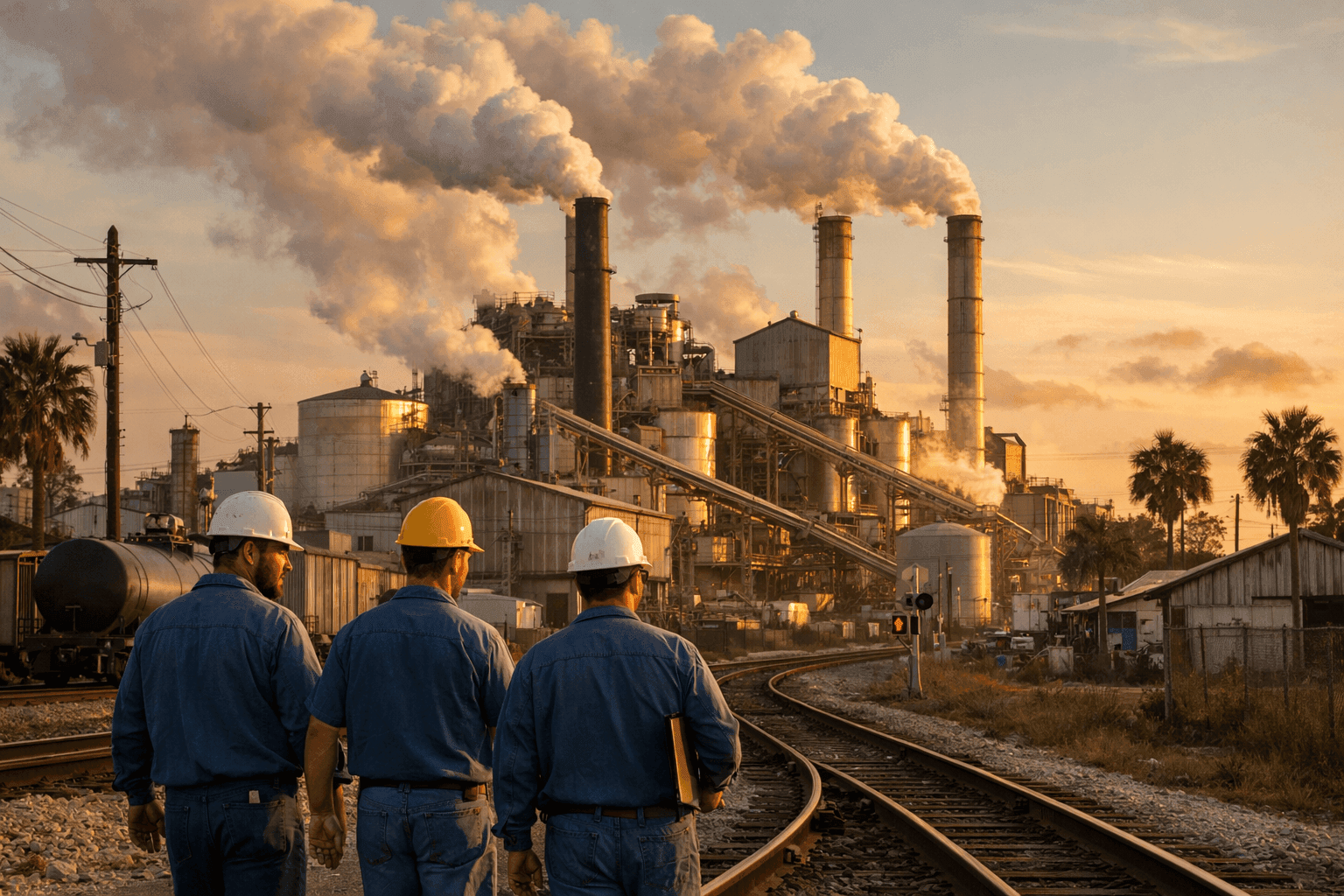
GTA VI's industrial areas represent some of the game's most atmospherically distinctive environments. The sugar refineries of central Leonida, the container yards of Port Gellhorn, the chemical plants along the Leonida River — each location combines authentic industrial architecture with the criminal operations that hide within legitimate business infrastructure. It's a world of shift workers and security guards, of loading docks and rail yards, of operations that run 24/7 because crime doesn't take weekends off.
Sugar and Snow
The Refinery Connection
Leonida's sugar industry has been a cornerstone of the state's economy for over a century. Vast fields of sugarcane feed into processing facilities that refine raw cane into the white crystalline product that sweetens America's food supply. The irony is not lost on anyone in law enforcement: these same facilities, with their industrial-scale chemical processing equipment, temperature-controlled storage, and legitimate shipping logistics, provide perfect cover for processing a different white crystalline product.
In GTA VI, the sugar refineries serve as both mission locations and business opportunities. Several key story missions take place within these facilities, requiring players to navigate complex industrial environments — catwalks, processing floors, storage silos, and rail loading areas — while avoiding or neutralizing security. The environmental design leverages the visual similarity between legitimate sugar processing and cocaine refinement, creating spaces where the legal and illegal operations are physically intertwined.
The gameplay implications extend beyond individual missions. Players who gain control of refinery operations through the game's property system can establish passive income streams that combine legitimate sugar revenue with drug processing profits. Managing these dual operations requires balancing production schedules, managing worker awareness, and maintaining the appearance of normalcy that keeps law enforcement from looking too closely.
The refineries also introduce unique stealth mechanics. Unlike urban environments where combat is often the default solution, industrial facilities reward patience and planning. Security patrols follow predictable routes. Processing equipment creates noise that masks movement. Shift changes create windows of reduced oversight. Players who approach these environments with military precision — a natural fit for Jason's character — find them far more manageable than those who default to aggression.
Port Gellhorn
Gateway to the World
Port Gellhorn is Leonida's primary deep-water port — a massive facility that handles over 40% of the state's international trade. Container ships from South America, the Caribbean, Europe, and Asia dock daily, unloading thousands of containers that pass through customs inspection at a rate that makes thorough checking physically impossible. For criminal organizations, this volume represents opportunity: hide a needle in a haystack of legitimate commerce, and the odds of detection become negligibly small.
The port's criminal ecosystem is layered and complex. At the lowest level, dock workers supplement their wages by looking the other way when certain containers are moved outside normal protocols. Mid-level operators — corrupt customs officials, compromised shipping agents, and logistics coordinators — ensure that flagged containers bypass inspection. At the highest level, shipping company executives and port authority officials maintain the systemic corruption that allows industrial-scale smuggling to operate as routine business.
GTA VI's Port Gellhorn missions leverage this layered structure to create gameplay that rewards understanding systems rather than just applying force. Players must identify which dock workers can be bribed, which customs officials are already compromised, and which shipping schedules create optimal windows for moving contraband. The port operates on a dynamic schedule — ships arrive and depart according to in-game time — creating time-pressure elements that add urgency to smuggling operations.
Blue-Collar Crime
One of GTA VI's most distinctive narrative contributions is its portrayal of blue-collar criminal networks — organizations composed not of flashy gangsters or corporate criminals but of working-class people who supplement inadequate wages with illegal activity. These aren't career criminals; they're truck drivers who carry extra cargo, warehouse workers who mislabel shipments, and mechanics who modify vehicles for purposes their manufacturers never intended.
This criminal stratum provides unique mission types that differ significantly from traditional GTA content. Rather than shootouts and car chases, blue-collar missions often involve logistics puzzles: routing shipments through inspection-free corridors, timing deliveries to coincide with shift changes, and maintaining cover stories that explain unusual activity. The tension comes not from combat but from the constant threat of discovery — the knowledge that one suspicious supervisor, one unexpected inspection, one talkative coworker could unravel everything.
The industrial zones also serve as a visual and tonal counterpoint to Vice City's glamour. While the city's entertainment district pulses with neon and excess, the industrial areas are defined by rust, concrete, and the grinding rhythm of machinery. The workers here don't dream of penthouse apartments and sports cars — they dream of making rent, keeping their families fed, and maybe saving enough to escape the cycle that traps them. Their criminality isn't aspiration; it's survival.
This tonal diversity is one of GTA VI's greatest strengths. By portraying crime across the entire economic spectrum — from Ambrosia's white-collar fraud to the industrial zones' blue-collar smuggling — Rockstar creates a world that feels authentically complex. Crime in Leonida isn't a single story; it's a thousand stories, each shaped by the economic pressures and opportunities that define different communities within the same state.